Minister of State for Sport and Postal Policy, Charlie McConalogue said:
“Since it started the ISM has given the Government, Sport Ireland, National Governing Bodies, and Local Sports Partnerships the evidence needed to make better decisions, target investment more effectively, and build a stronger sports sector. The results highlighted here are a great reflection on the fine work of thousands of clubs, coaches, and volunteers across Ireland. They deserve our thanks.”
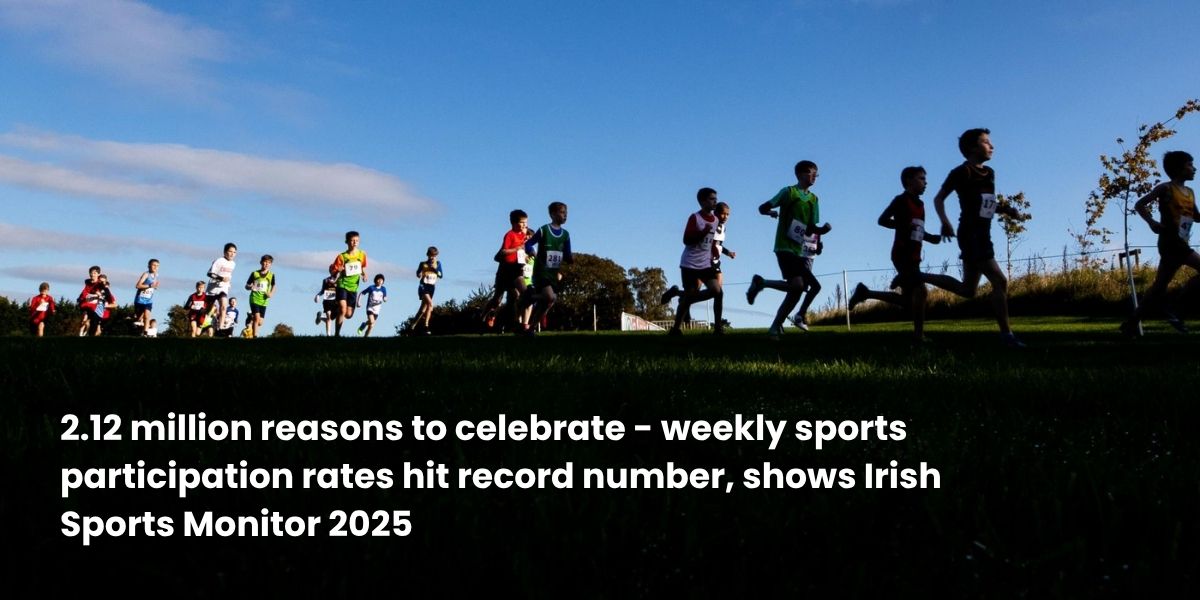
Weekly sports participation rates in 2025 (48.4%) are not statistically significantly different to 2024 (48.5%) and a growing population means there were more people participating every week in 2025 than 2024. However, weekly recreational walking rates are down by 4 percentage points compared to 2024, returning to pre-pandemic levels.
Two out of every five people are highly active through sport and recreational walking. The decline in percentage of highly active people and the increase in percentage of sedentary people between 2024 and 2025, is largely driven by the decline in recreational walking.
The report also showed that there was a 4-percentage point difference in male and female sports participation rates in 2025, up by one percentage point from 2024.
Sport Ireland CEO Dr Úna May said:
“These figures tell a positive story – more people in Ireland are active in sport than ever before. When people are active throughout their lives, the benefits extend to their physical health, their mental wellbeing, their social connections, and their communities. At Sport Ireland we’re committed to extending these benefits to as many people as possible through implementing evidence-based strategies.
“The Department of Culture, Communications, and Sport, our National Governing Bodies, Local Sports Partnerships, clubs, coaches, and volunteers are all part of making that happen. They have done tremendous work in creating the conditions where every person in Ireland, at every stage of life, can find their place in sport and keep coming back to it.”
The survey shows 38% of the population meet the national physical activity guidelines through sport and recreational walking alone, down from 40% in 2024. This decline is largely driven by the decline in recreational walking.
John Foley, Sport Ireland Chairperson, said:
“Participation is growing, but our responsibility is to ensure that growth is sustained, inclusive, and built on solid foundations. That means rigorous investment decisions, strong partnerships with National Governing Bodies and Local Sports Partnerships, and a continued commitment to the governance standards that underpin a healthy sports sector.
“The gap in active sports participation between higher and lower socioeconomic groups has widened to 22 points – up from 19 points in 2024 and 16 points in 2017. This trend is a significant challenge and demands a targeted, evidence-based response.”
The ISM also showed that more work needs to be done in certain areas.
Sport Ireland’s Participation Plan 2025-2027 addresses this through our network of Local Sports Partnerships, which are uniquely placed to work with disadvantaged communities, teenagers, older people, ethnic minorities, and people with disabilities.
Other measures, such as the ESF+ Sport4Empowerment programme, which aims to enhance the wellbeing, education and economic prospects of people at risk of social exclusion, and Dormant Accounts funding are being deployed to work in this area.
Benny Cullen, Director of Research and Innovation at Sport Ireland, said:
“I want to thank all those who helped produce this important report, including our research colleagues in IPSOS B&A.
“But this is not a moment to stand still. The data shows us where participation is growing, where gaps remain, and where we need to do more. It’ll be important in work towards promoting sport participation and physical activity in society. While much work remains to be done it is pleasing to see growth in several areas.”
The participation gap between people with and without disabilities narrowed to 19 points in 2024 – an encouraging trend, and although we have seen an increase in weekly sports participation rates for people with disabilities from 29% in 2017 to 34% in 2025, significant work remains.
Sport Ireland is responding with sustained investment – including €1.2m to fund Sports Inclusion Disability Officers across all 29 Local Sports Partnerships in 2024 – and through initiatives like the first-ever National Disability in Sport Week, launched in 2025.
PRESS RELEASE ENDS
For more information, please contact Sport Ireland Communications
About Sport Ireland
Sport Ireland is the authority tasked with the development of sport in Ireland, including participation in sport, high-performance sport, anti-doping, coaching, and the development of the Sport Ireland Campus.
About the Irish Sport Monitor report
The Irish Sport Monitor (ISM) report provides the latest insights on sporting behaviours, beliefs, and attitudes. The ISM is one of the world’s longest-running national surveys, collecting data on sport participation and physical activity for over 8,500 Irish individuals aged 16 years and older.